

Palestinian Merchants in Al-Quds Old City : between heritage, occupation, and resistance
Written by Sinem
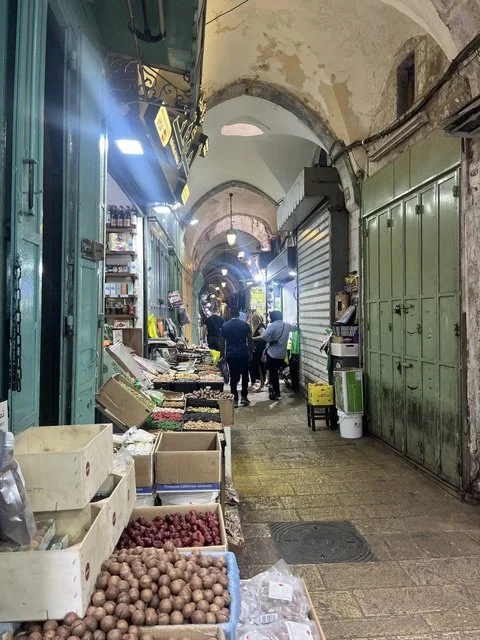
For generations, Palestinian merchants have stood at the heart of Al-Quds Old City, where the souks have been shaped by a dense network of small family-run businesses, some of which have been operating from the same location for several decades, or even more than a century. Yet the continuity of these family business has been shaped by a political and colonial regime that, since 1967, has progressively transformed the conditions of Palestinian life in East Al-Quds. A combination of land confiscation, settlement expansion, discriminatory planning and zoning regulations, restrictions on residency and movement, home demolitions, and the appropriation of Palestinian property has profoundly reshaped the social and spatial fabric of the city. Theses policies penetrate the everyday spaces in which Palestinian families work, trade, move, socialise, and reproduce their livelihoods. The Old City’s merchants are therefore affected firstly as business owners, and secondly as residents whose economic activity is inseparable from their access to the city, their neighbourhoods, their customers and the physical spaces inherited from previous generations. When access to the Old City is restricted, when surrounding Palestinian families are displaced, when streets are militarised, or when settler presence and violence disrupt everyday movement, the effects extend into these wider networks. The continuity of the social worlds in which these businesses are embedded is threatened.
Palestinian presence in the Old City is particularly significant because it persists within a space where Israeli state policies and settler practices seek to reshape the Old City and Al-Quds itself. The continued presence of Palestinian families, businesses, and social networks therefore represents a form of resilience, an ongoing assertion of belonging and rootedness in a city of profound significance to Palestinians. The memory of how a father, grandfather, or great-grandfather sustained the business during an earlier period of upheaval can itself become a resource for navigating the present. This article therefore proposes a rediscovery of Al-Quds’s Old City from the perspective of those who inhabit, work in, and sustain it. Their narratives offer a way of tracing how political and colonial processes are experienced at the scale of the family, the shop, the street, and the market.
1. Al-Quds before tourism
Today, the Old City of Al-Quds is synonymous with souvenirs. When walking through its narrow stone alleys and shop after shop are overflowing with olive-wood crosses, embroidered scarves, ceramic plates, handcrafted jewelry but also many cafes and restaurants. But this situation wasn’t always the case. The same streets told a very different story during the 18th century. Before the tourist industry reshaped the landscape, the souks of Al-Quds were not designed for visitors, but they were designed for locals. Meat, spices, textiles, olive oil: these were the goods that filled the stalls. Traditional specialised markets have increasingly been replaced or supplemented by shops oriented towards tourism. Souqs once renowned for specific forms of trade such as Souq al-'Attarin (the Spice Market), Souq al-Lahamin (the Butchers’ Market), and Souq al-Qattanin (the Cotton Market) have increasingly become spaces dominated by souvenir shops and tourism-oriented commerce. The shops that now sell souvenirs once sold sustenance. Several shopkeepers interviewed recall this transformation. In the Khan az-Zeit neighborhood, a souvenir shop that was once dedicated to groceries sums it up:
"This shop is from 1910 and was opened first by my great grandfather. Before, this was a groceries shop. People came here to buy fruits and vegetables. Then in 1967 my father chose to open a jewelry shop because he knew how to make them. And until now it stayed like this.”
The names themselves indicate that these markets were primarily devoted to everyday commodities: meat, textiles, groceries intended for local consumption and many more. This observation is corroborated by two of the interviewees, one of whom noted that the quarter in which his shop now stands was originally a meat market, frequented by residents in search of their daily provisions. Another recalled that his premises had functioned as a grocery shop before changing to shoe shop prior in 1937. Changes in the nature of shops prior to 1949 still fell within the realm of the everyday.
“At first this was a grocery shop, then in 1937 it became a shoe shop. We only made the restaurant 4 years ago.”
Each bore witness to a bustling, diversified local economy for a local clientele. On the thoroughfare leading from Damascus Gate, for instance, a market specialized in olive oil once thrived; to this day, the street retains the name Souq Khan al-Zeit, the Oil Market. As one interviewee recounted, the Old City functioned as a regional commercial hub. Shoppers did not merely come from within the city walls, but from the surrounding towns and villages of the West Bank, from within the 1948 territories, and even from farther afield like Gaza, and occasionally neighboring countries :
"People from the West Bank, from everywhere, used to come here to buy lamb meat. Even people from Jordan, Lebanon, Syria from Damascus, came here…, that's why Bab al-Amud is called Damascus Gate."
Visits by tourists and foreigners multiplied in the late 19th century, as the growing influence of European powers over the Ottoman Empire guaranteed the safety of their nationals within its territory. Furthermore, Western Christian interest in the Holy Land sparked new waves of Protestant pilgrims, although they never matched Orthodox pilgrims (from Russia and Eastern Europe) in either numbers or fervor. Many of these Western visitors belonged to the wealthy classes, as the nascent tourism industry with its luxurious modes of transport remained beyond the means of most people[1]. Traditional craftsmanship faced a significant threat later in the century, as artisans turned to new technologies in an effort to remain competitive in an evolving market. In the 1960s, for instance, electric machinery began to appear in olive-wood carving workshops across the city. While these innovations dramatically accelerated production timelines and reduced labour requirements, enabling artisans to produce twelve pieces in the time previously required to carve a single item by hand, this mechanisation came at a considerable cost. The quality of local craftsmanship suffered noticeably as a result, with intricacy and individuality giving way to uniformity and expediency. In the decades that followed, the number of artisans continuing to produce their wares by hand dwindled steadily. Today, such practitioners have become increasingly rare. The market has consequently become saturated with standardised, lower-quality iterations of Al-Quds's traditional crafts, mass-produced objects that, while superficially reminiscent of their handcrafted predecessors, lack the distinctive character and artisanal integrity that once defined the city's material culture[2].
In addition to these technological shifts, a parallel development further undermined the integrity of Al-Quds's traditional crafts which is the growing influx of imported goods from manufacturing centres such as China and India. As genuine, handcrafted items became increasingly scarce, a number of merchants opted to supplement their inventories with foreign-made products. Yet others chose to resist this trend, adhering steadfastly to traditional methods as an act of sumud(steadfastness) and, more pragmatically, out of a profound sense of familial responsibility. As one merchant located near the Eighth Station of the Via Dolorosa explained to us:
"A lot of shopkeepers have things coming from India, China… but me, I can't do this because it's a family business. Ten families across the West Bank and Gaza are working for this shop. If I do this, I'll lose my family and they will lose everything."
For him and others like him, the preservation of traditional craftsmanship was inseparable from the preservation of kinship networks and collective identity.
Compounding these commercial pressures was a demographic and spatial transformation that unfolded over the course of the twentieth century. Residents of the Old City gradually relocated to the modern neighbourhoods of what came to be known as "New Jerusalem." Simultaneously, shopping malls and retail centres emerged beyond the city walls, offering a new and increasingly attractive alternative to the traditional souks[3]. The Old City's markets, once bustling hubs of regional commerce, began to lose their specialised functions and, with them, their clientele. Economic activity within the walls entered a period of steady decline. One interviewee, reflecting on this transformation :
"Before, the clients were merchants from the West Bank who came to buy everyday goods, cheap things, meat like sheep. It was very lively. In the past, this was the main souk. After we started to have malls and shops everywhere outside the walls, everybody moved to shop there. Now there is no place to shop in the Old City, plus the difficulty to come here."
He was referring not only to the shifting commercial geography but also to the growing physical and administrative barriers that gradually rendered the Old City less accessible. Over time, checkpoints and frequent security controls made entry increasingly cumbersome. These cumulative obstacles progressively dissuaded residents from making the journey into the Old City, accelerating its economic decline and further distancing it from its historical role as a vibrant centre of daily trade. Indeed, the period following 1948 witnessed a further decline in tourism. Under Jordanian administration, which lasted from the annexation of the West Bank in 1950 until the Six-Day War of 1967, the tourism sector stagnated and souvenir shops remained few in number. The Jordanian authorities exercised strict control over commercial licences, granting approval to only a handful of establishments. The urban fabric of East Al-Quds had suffered greatly from the loss of its main commercial centres, which had been located in the western part of the city prior to 1948, neighbourhoods such as Qatamon, Talbiyeh, and the Jaffa Road area [4]. The division of the city by barbed wire, concrete barriers, and checkpoints following the 1949 armistice agreement effectively severed East Al-Quds from its historical economic and commercial heart. For the average traveller of the era, a pilgrimage to Al-Quds was fraught with logistical and political hurdles. Situated in an Arab country, the city's accessibility was heavily constrained by the region's volatile geopolitics. Despite the existence of armistice agreements, the principle of free access to the Holy Places remained largely theoretical. As Nusseibeh later highlighted before the UN, the occupation effectively barred millions of Christian and Muslim Arabs from worshipping in Al-Quds and across Palestine for decades. He described the Palestinian residents of Al-Quds as being treated as mere "guests" in their own city, stripped of their human dignity[5]. These persistent restrictions, coupled with an extremely stringent licensing system for shops, meant that souvenir vendors remained a rare sight in the Old City throughout the Jordanian period. Indeed, under Jordanian rule, merchants enjoyed protected tenant status under the law governing protected tenancies that was in effect during the British Mandate and Jordanian rule. However, this law was abolished by Israel in 1968 and replaced by a so-called "third-generation" law that allowed for the seizure of properties[6].
2. How the occupation economy restricts Palestinian merchants
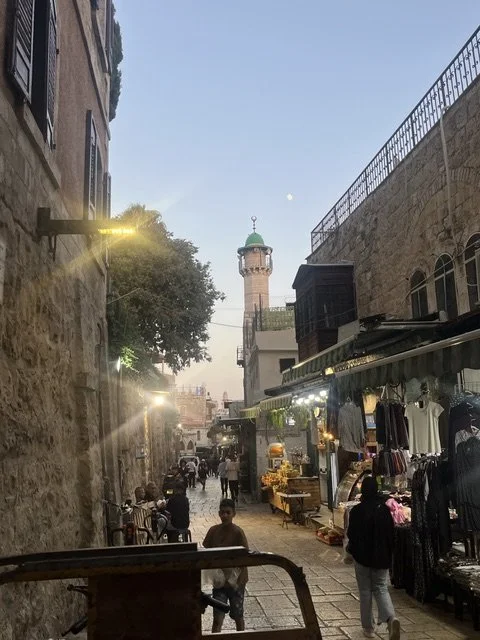
One recurring element in the interviews was the reluctance to speak openly about the period following 1967. Several interviewees appeared hesitant, and at times even fearful, when asked about the political and social transformations that followed the war. Some interviewees tended to avoid the political dimension of the period and instead focused on the visible increase in tourism. Others described the growing number of visitors by referring to the large numbers of Israeli settlers began visiting the city, coming not only from major urban centres but also from surrounding kibbutzim. One person recalled that on Saturdays there were so many people that it was sometimes impossible to move through the streets. According to several interviewees, they were attracted in part by the relatively inexpensive goods available in the city, but also by its traditional handicrafts[7]. This change in the composition of the clientele have had a direct impact on local commercial practices. According to some of the interviewees, traditional handicrafts were purchased in large quantities by Israeli visitors and gradually became increasingly difficult to find. This scarcity raises important questions regarding changes in local production and the sustainability of traditional crafts. The testimony of a restaurant owner is particularly illustrative of this transformation. He explained that, after 1967, the number of Jewish tourists visiting his establishment became incomparable to that of Arab visitors, whereas before 1967 his restaurant had been an important meeting place for Arabs from neighbouring countries :
“Every day I sat one hour counting people. In one hour I was counting like 280 Jews and only 3 Arabs, and they were from the neighborhood. There were many tourists as well, coming from everywhere, from all Europe and America…tourists started coming in large numbers and the situation changed.”
A space that had previously been integrated into regional Arab networks of mobility and consumption was increasingly frequented by Israeli and Jewish visitors. This experience is corroborated by post-1967 data; in 1970, it was estimated that 60% of all tourists visiting Israel were Jewish, while 40% were non-Jewish. Nearly 40% of tourists were American[8].
This transformation must also be understood within the broader context of the closure of borders and the disruption of commercial and social connections with neighbouring Arab countries. Following 1967, Arab visitors who had previously travelled to the city were no longer able to do so with the same ease. The interruption of these cross-border movements therefore affected the commercial networks upon which local businesses had previously depended. The crucial import of raw materials and specific crafted goods from these regions was cut off, disrupting established supply chains. Visits from tourists in Jordan, Syria, and other neighbouring countries ceased entirely. The city lost part of its traditional clientele while merchants simultaneously faced disruptions in their supply networks. The transformation of the artisanal sector must also be considered in relation to the displacement of artisans and the broader demographic consequences of the Nakba of 1948 and the annexation in 1967. A significant number of artisans were displaced or became refugees, which disrupted established networks of production and transmission of artisanal knowledge. The very human fabric that had woven the city's artisanal identity was torn. The resulting reduction in the number of craftspeople have contributed to the disappearance or of certain traditional products. This new demand, combined with dwindling local supply, pushed the merchant class towards a pragmatic but ultimately transformative adaptation. To meet the demands of this unprecedented tourist population, many traditional shops were gradually refashioned into souvenir shops, a shift that would come to define the modern commercial identity of the Old City. In the late 1980s, the political situation deteriorated with the outbreak of the First Intifada. Tourism numbers plummeted and have remained below the levels of previous decades ever since.
“After intifidada, I had to close for a long time…Then we opened but closed later again. This cycle repeats.” Shops are now limiting themselves to selling only the most profitable products, or else they remain closed. One of the merchants showed me entire rows of stores that have shut down completely.
The mid 1990s marked the formalization and intensification of a regime of closure that would accelerate the very transformations witnessed after 1967. Beginning in 1993, a new bureaucratic architecture of control was instituted, fundamentally altering the relationship between the Old City, the wider West Bank, and the Gaza Strip. A work permit system, mandated by the Israeli government, was imposed on all Palestinian territories, creating a formalized and restrictive regime for movement. This system, managed through a proliferating network of checkpoints, created a de-facto differentiation between permitted workers and other Palestinians, effectively barring many from entering Israel and East Al-Quds without prior authorization. While the permit system created bureaucratic obstacles, the landscape itself was being physically reshaped[9]. The construction of the annexation wall, though not completed until the 2000s, had its conceptual and logistical roots in this period of enforced separation. Subsequent decades saw the proliferation of hundreds of internal checkpoints, gates, and roadblocks across the West Bank, intended to limit Palestinian mobility. For a merchant in the Old City, whose supply chain depended on families across Gaza, Hebron, and Bethlehem, these barriers were devastating. The ease of access that had once defined the Old City as a regional hub was replaced by a system of prohibitive movement. Merchants now devise elaborate strategies just to move their merchandise. As one shopkeeper explained:
"I have to bring items and goods from Hebron and Ramallah. I do a lot of shopping at the same time and hide these objects at the bottom under shopping bags to conceal them."
The burden is financial. Disproportionate property taxes imposed by the municipality have forced some workshops to close or threaten the very viability of their businesses, making the production of their own goods or the maintenance of their shops unprofitable.
"I pay the Al-Quds municipality 63,000 [shekels] per year and 3,000 every month. Despite closures, I keep paying. During Covid, we had to close. I give from my own pocket to keep the shop alive."
Another shopkeeper, a café and juice bar owner, revealed similar struggles:
"I pay 40,000 [shekels] per year in taxes, 67,000 because of taxes. If I don't pay, I can't leave the country. And there is a specific time to pay, I have to pay in time. I need new machines but I can't afford them. There is no real income."
During Ramadan, one merchant told us his shop was closed for 40 days to prevent gatherings. At the same time, Jewish-owned establishments remained open. This disparity, he noted, highlights the general neglect of Palestinian neighbourhoods in the Old City and the fact that the municipality does not treat these areas the same way it treats Jewish quarters of Al-Quds. Beyond this, there are the everyday inconveniences that make coming to the Old City increasingly difficult and discouraging. Parking, for example, is extremely scarce in East Al-Quds, and fines are issued frequently without clear explanation. It has become genuinely hard to come to East Al-Quds. The municipality doesn’t take care of theses issues, and its attention is unevenly distributed. On the Jewish side, these problems simply do not exist.
3. Resistance and survival in the face of occupation in Al-Quds’s Old city
This reluctance to discuss the post-1967 period is itself significant and suggests that silence, hesitation, and indirect forms of narration should also be considered as meaningful elements of the testimonies. Indeed, this offers insight into the tangible impact these policies have had on people, and specifically a sense of suppression. Al-Quds’s unique atmosphere has always fostered this dynamic, but it has intensified in recent years, and even more so since October 7th. People are imprisoned for trivial reasons even just for a "like" on Facebook. Their shops face direct threats, endangering both the business owners and their families. The occupation controls every aspect of life. By engaging with these silences as data, I begin to understand the profound and subtle ways in which occupation affects everyday life. The merchant's refusal to speak directly is a form of storytelling. Their fear, echoed in the broader patterns of emotional suppression among Palestinians in East Al-Quds, reveals the deep psychological costs of living under a system of control where everyday life is shaped by continuous, anticipated threat.
To speak is to risk arrest. The most recent and emblematic example is that of the booksellers from a bookshop, arrested in February 2025 during a raid on their store. The initial charge of "supporting terrorism" was later downgraded to "disturbing public order".[10] It even happens that tourism officers pose as tourists to probe shopkeepers about their opinions regarding the war in Gaza.
" They came as tourists and asked about Gaza. A few days later, the authorities came to my shop. "
Despite the overwhelming pressures, the merchants of the Old City resist. Their sumud is a profound act of cultural and political steadfastness, a daily reaffirmation of presence in a city where their very existence is contested. For many, this resilience is rooted in a deep sense of familial duty and inherited obligation. The decision to remain, to continue trading in the face of overwhelming adversity, is not made lightly. As one merchant explained,
"I’m not allowed to change (to work somewhere else) because it’s family business! If I change something, I change something from my family."
This is a recognition that the shop is a living archive of family history, a material testament to generations of presence in the city. One restaurant owner, whose establishment occupies a prime location in the Old City, recounted the extraordinary offers he has received:
“They tried to buy the shop from 24 million dollar, 31 million, 40 million dollar. Someone even offered money if I put his name on the toilet door. But I always refused. My father wrote in his that he’ll curse me if I sell the place. So I can't even think about it."
This resilience requires active resistance, a willingness to confront the authorities and bear the consequences. The restaurant owner who refused the multi-million dollar offers has faced a sustained campaign of harassment from the Israeli authorities. He has been subjected to repeated legal proceedings: a court case accusing him of illegal digging under the pretext of searching for archaeological artifacts. He was arrested, released only upon payment of a $10,000 fine, and a camera has been installed by the authorities, pointed directly at his restaurant.
"You see this camera behind you? The authorities admitted that it was only for me. They said, 'We watch you, so be careful.'"
This surveillance is a direct attempt to break him. But he remains, as does his father's curse, as does the shop itself. This shows the family's connection to the land and its place in the city. As another merchant stated, "What your father leaves you is worth all the gold in the world." The true inheritance is the legacy of resistance, the tradition of remaining, the refusal to be displaced.
Sumud is a daily practice of refusing to be erased. For the merchants of the Old City, it manifests in the simple act of opening their shops each morning, of continuing to produce and sell their crafts, of welcoming visitors despite the obstacles. When asked what helped him to continue, one merchant responded simply:
"People. People coming to the old city. When they come visit, it’s a big support for us. The most important thing is that we need people to come. To witness."
Another merchant, reflecting on his own motivation: "I must continue the story of my family and also because living in the Old City comes with a lot of blessings. Working in the old city is something in my blood. I can't imagine working somewhere else."
Their daily lives are shaped by policies designed to erase them, but they remain. As custodians of tradition and as living embodiments of a history that refuses to be silenced.
Bibliography
Association for Civil Rights in Israel. (2026, February 16). Police photography of protesters. https://www.english.acri.org.il/post/police-photography-of-protesters
Arafeh, N. (2016, July 27). The current state of the markets in the Old City of Jerusalem (Background Paper, Roundtable No. 5). Palestine Economic Policy Research Institute (MAS). https://yplus.ps/wp-content/uploads/2021/01/Arafeh-N.-The-Current-Status-of-the-Markets-in-the-Old-City-of-Jerusalem.pdf
Daʿadli, T., & Barbé, H. (2017). The development of Sūq al-Qaṭṭānīn quarter, Jerusalem. Der Islam. https://www.degruyterbrill.com/document/doi/10.1515/islam-2017-0004/html?srsltid=AfmBOoo0lggGJVwG98hqIJAgOEAEdhhjCosSwIl8k2T-KYqSli7MBrYB
European Coordination of Committees and Associations for Palestine. (2014, September). EU obligations and duty to end Israeli policies of forcible transfer, colonialism and apartheid in occupied East Jerusalem [Brochure]. https://www.eccpalestine.org/wp-content/uploads/2014/10/triptych14web.pdf
Human Rights Watch. (1996, July). Israel’s closure of the West Bank and Gaza Strip (Vol. 8, No. 3[E]). https://www.hrw.org/reports/1996/Israel1.htm
Nassar, I. (2003). In their image: Jerusalem in nineteenth-century English travel narratives. Jerusalem Quarterly, (19). https://doi.org/10.70190/jq.I19.p6
Nasasra, M. (2026). Urban development of Jerusalem under Jordanian rule: Narrating the Jerusalem International Airport, 1948–1967. Ostour, 12(24). https://doi.org/10.31430/BRCP2425
Price, E. (2001). Jerusalem for sale: Souvenirs, tourists and the Old City. Jerusalem Quarterly, (11–12),https://www.palestine-studies.org/sites/default/files/jq-articles/11_jerusalem_for_sale_1_0.pdf
Tufakji, K. (2015). Third generation law: Altering Jerusalem’s Palestinian demographics. Palestinian Vision Organization. https://palvision.ps/wp-content/uploads/2023/08/Third-Generation-Law.pdf
United Nations Security Council. (1980, June 24). Security Council, 35th year: 2234th meeting (S/PV.2234). United Nations. https://digitallibrary.un.org/record/25607/
Notes
[1] Nassar, I. (2003). In their image: Al-Quds in nineteenth-century English travel narratives. Al-Quds Quarterly.
[2] Price, E. (2001). Jerusalem for sale: Souvenirs, tourists and the Old City. Jerusalem Quarterly
[3] Arafeh, N. (2016). The current state of the markets in the Old City of Jerusalem (Background Paper, Roundtable No. 5). Palestine Economic Policy Research Institute (MAS).
[4] Nasasra, M. (2026). Urban development of Jeruslaem under Jordanian rule: Narrating the Jerusalem International Airport, 1948–1967. Ostour
[5] United Nations Security Council. (1980, June 24). Security Council, 35th year: 2234th meeting (S/PV.2234). United Nations.
[6] Tufakji, K. (2015). Third generation law: Altering Jerusalem’s Palestinian demographics. Palestinian Vision Organization.
[7] Arafeh, N. (2016). The current state of the markets in the Old City of Al-Quds (Background Paper, Roundtable No. 5). Palestine Economic Policy Research Institute (MAS)
[8] Price, E. (2001). Al-Quds for sale: Souvenirs, tourists and the Old City. Al-Quds Quarterly
[9] Human Rights Watch. (1996, July). Israel’s closure of the West Bank and Gaza Strip (Vol. 8, No. 3[E])
[10] Association for Civil Rights in Israel. (2026, February 16). Police photography of protesters.